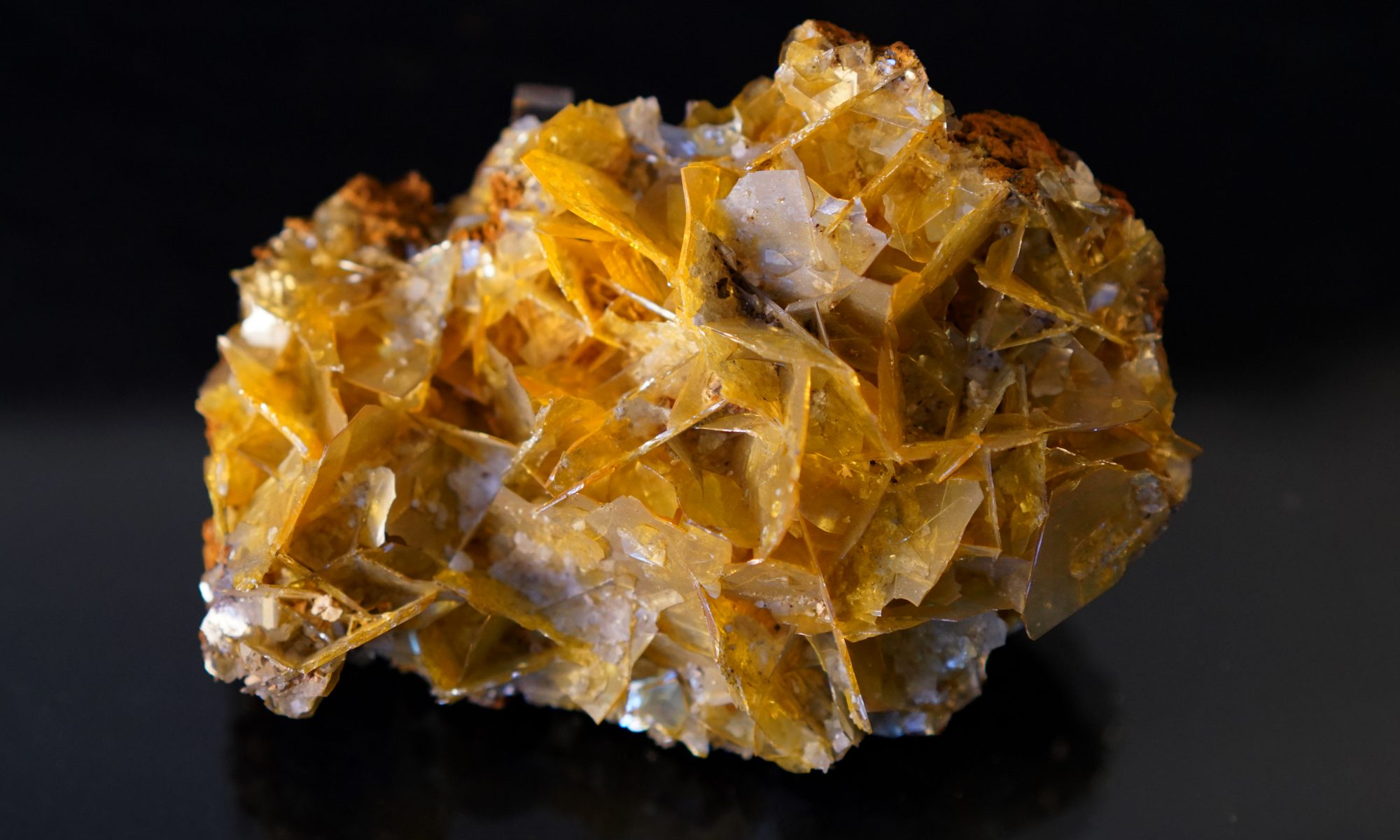
Cataloging minerals, part 1: The categories of colonialism and extraction
Selby Hearth, Carrie Robbins
Carrie Robbins, Selby Hearth
Cataloging mineral extraction histories:
Proposing a revised catalogue record for V.4476
I. Naming the Mineral
Revised Field Name: IMA-Approved Mineral Names
Revised Entry for V.4476: Azurite on Malachite
Previous Catalogue Fields Used: Specimen (1925, 1958, 1979); Mineral Name (c. 2000)
Revised Field Name: Non-IMA-Approved Mineral Names
Revised Entry for V.4476:
1) ongopolo (Oshindongan) or oshikushu (Oshindongan): Copper ores from this site were central to the economy of the Ovambo Kingdom of Ondonga prior to German colonization in the late 1800s (Hearth 2021 reviews early colonial records from this mine at the time of colonial contact). A 2004 Oshindonga/English Dictionary lists ‘copper’ as ‘ongopolo, oshikushu’ (Viljoen et al. 2004: 71); however, it is unclear which copper species Ndongan coppersmiths used (indeed, it was likely many copper species, possibly including azurite).
Cataloguer: S. Hearth (10 January 2023)
Community Feedback: None recorded.
2) uueendje (Oshindongan): An 1891 paper by traveling Swiss botanist Hans Schinz reported that the Ndongan smiths he met called the copper ore they smelted “uueendje” (Schinz 1891: 351).
Cataloguer: S. Hearth (10 January 2023)
Community feedback: None recorded.
3) otjikoporo or ongoporo (Otjiherero): At the time of German colonization, Herero communities also claimed historical relationships with copper in this area (see summary in Hearth 2021). Schinz (1891: 351) reported that Otjiherero speakers he encountered called copper ‘otjikoporo’ (which he interpreted as being derived from the English word ‘copper’) or ‘ongoporo.’
Cataloguer: S. Hearth (10 January 2023)
Community feedback: None recorded.
4) n/a (Haiǁom): At the time of colonial contact, copper from this site was central to the economy of Haiǁom San communities in that area (see summary in Hearth 2021). This record has no information about mineral terminologies from the Haiǁom.
Cataloguer: S. Hearth (10 January 2023)
Community feedback: None recorded.
II. Naming the Mine (Locality of Extraction)
Revised Entry for V.4476: Ongopolo Mine, Tsumeb, Oshikoto Region, Namibia, Africa, MinDat loc-2428; see also: Otavi Mountains, Otavi District, Otavi Group, Damara Supergroup, German South-West Africa, Deutsch-Südwestafrika, South-West Africa, Kingdom of Ondonga (see Hearth 2021, Hearth 2023); Hereroland (see Hearth 2021), Damaraland (see Hearth 2021).
Cataloguer: S. Hearth (10 January 2023)
Community feedback: None recorded.
III. Remembering All that Enabled the Extraction
Revised Field Name: Date of Extraction
Revised Entry for V.4476: No information.
Revised Field Name: Names of Guides, Miners, or Labourers
Revised Entry for V.4476:
Guide’s name or ethnicity: San Haiǁom guides were instrumental in leading geologists to the copper mines at Tsumeb and Otavi in what is now Namibia (Hearth 2023).
Miner’s name or ethnicity: None recorded; however, miners came to work at Tsumeb from the Ovambo Kingdom of Ondonga, Herero, San Haiǁom, and South African communities (Hearth 2021, Hearth 2023).
Cataloguer: S. Hearth (10 January 2023)
Community feedback: None recorded.
Revised Field Name: Labour conditions
Revised Entry for V.4476:
Labour conditions: from 1893 to 1996, the Tsumeb Mine was opened by labourers from the Haiǁom and Herero communities, as well as from several of the Kingdoms of the Ovambo (see Hearth 2021 summary). Additionally, people from Cape Colony regularly traveled by ocean steamers to Walvis Bay, then overland via the OMEG railway to Tsumeb, to work as temporary labourers, usually returning home after a fixed term of service. At the time of this sample’s acquisition (1920s), the labourers were working under the ‘Contract Labour’ system that South Africa put into place when the League of Nations gave them a mandate over the formerly-German colony post World War I (e.g., Cooper 1999; see summary in Hearth 2021).
Cataloguer: S. Hearth (10 January 2023)
Community feedback: None recorded.
Revised Field Name: Occupational health and safety conditions
Revised Entry for V.4476:
No citations recorded.
Community feedback: None recorded.
IV. Collecting the Collector
Revised Field Name: Collector’s Name
Revised Entry for V.4476:
George Vaux Jr. (1863-1927) assigned this specimen the number 4476
Revised Field Name: Provenience and Provenance
Provenience is sometimes understood as a synonymous term for provenance, but there are field specific uses that allow for productive distinction. For geologists, provenience refers to whence the sample was collected (Joyce 2012). A provenience history field can thus be used to account for any context about the findspot. Provenance in turn can be used as it is in other cultural collections to account for the history of a mineral specimen’s ownership (Getty AAT, n.d.)
Revised Entry for V.4476:
Provenience: The persons who extracted this specimen from the Tsumeb Mine remain unidentified. They were most likely mine labourers, as that is a common source of specimens in this era (Hearth 2023).
Provenance: It is also unknown how the specimen reached a mineral dealer. A later report from mineral collector Samuel Gordon (Gordon 1934) recounted that, upon visiting Tsumeb, he had to negotiate with the mine director for which specimens he would be allowed to buy. It is possible that the mine director controlled the flow of specimens from workers to dealers.
Vaux recorded what he knew about who had owned T.4476 on the back of the specimen’s tag. According to Vaux’s name-date notation style, “Ward 1923” likely means that this specimen was purchased from Ward in 1923, which almost certainly refers to Ward’s Natural Science, a mineral dealership based out of Rochester, New York. It is not recorded when the specimen arrived at Ward’s, but founder Henry Augustus Ward died in 1906 (the year that Tsumeb began industrial-scale operations), so it is unlikely that ‘Ward’ refers to the founder himself. Vaux also includes the notation ‘Maricher,’ which likely refers to the individual who purchased this specimen from Ward’s in 1923 and from whom Vaux purchased it in October 1925.
After Vaux’s death in 1927, the collection passed to his widow and sons. They donated the collection to Bryn Mawr in 1958.
Cataloguer: S. Hearth (10 January 2023)
Community feedback: None recorded.
Previous Catalogue Fields Used: Source and Date of Acquisition (1925), none subsequent to 1925
V. Environmental Context and Impact
Revised Field Name: Ecology
Revised Entry for V.4476:
No citations recorded.
Previous Catalogue Fields Used: none
Community feedback: None recorded.
Revised Field Name: Environmental and Public Health Impact
Revised Entry for V.4476:
The Environmental Justice Atlas records Tsumeb as a site of ‘Industrial and Utilities conflicts’ due to the lasting environmental and public health impacts of the copper smelter operational at the site from 1961 to present (Mazzuca 2019).
Cataloguer: S. Hearth (10 January 2023)
Community feedback: None recorded.
Revised Field Name: Land Rights and Relationships
Revised Entry for V.4476:
Rights to the land and copper in the Otavi region (including Tsumeb) were intensely contested during the early colonial period (1850-1906). Hearth (2021) details the conflict; a summary is presented here. The Haiǁom (whom Europeans called the ‘Bushmen,’ but constitute a nation within the San ethnic group) mined copper in the area from at least 1850 to at least 1895. They traded it north to the Kingdom of Ondonga, where coppersmiths smelted it, smithed it, and traded it. In 1885, a hunter from the Cape Colony named William Worthington Jordan claimed that King Kambonde kaMpingana of the Ovambo Kingdom of Ondonga had sold him the copper rights and much of the land in the region to found a Boer colony (the Republic of Upingtonia). However, King Kambonde disputed this, and Jordan was eventually murdered by the King’s brother, Nehale. A third community – the Herero – also claimed historical relationships with the land and copper in the area, though there are fewer records of this. Germany annexed the area as a protectorate in 1884, though they had almost no control over any of the land. From 1884 to 1892, the German colonial authority continued to claim rights to the copper, in addition to a British trader (Robert Lewis), the Paramount Chief of the Herero (Maharero kaTjamuaha), King Kambonde kaMpingana of the Ovambo Kingdom of Ondonga, the Deutsche Kolonialgesellschaft für Südwest-Afrika (DKGSWA; German Colonial Society for South West Africa), the British-owned Damaraland Company, and the joint-British-German South West Africa Company (SWACO). In 1892, the German Empire declared the Otavi area a ‘no man’s land,’ meaning they believed that no one had ever lived there and therefore Germany could decide what to do with it. They awarded control of the mineral rights to SWACO, which later assigned the mine to a German-owned subsidiary — Otavi Minen- und Eisenbahn-Gesellschaft (OMEG). During World War I, the Union of South Africa (a British dominion) invaded German South-West Africa, and captured the Tsumeb Mine. After the war, the League of Nations made the former German colony into a South African mandate, though they returned Tsumeb to OMEG. During German rearmament in the 1930s, the South African government closed the mine to deny Germany access to its copper. After World War II, the South African government auctioned Tsumeb to a set of American mining companies, including Newmont Mining Corporation and American Metal Climax Inc (AMAX). These became the Tsumeb Corporation Limited. As of 2023, the mine is closed but owned by Ongopolo Mining and Processing Limited (which is in turn owned by British corporation Weatherly International plc). As of 2010, the smelter at Tsumeb is owned by Dundee Precious Metals Inc.
Cataloguer: S. Hearth (10 January 2023)
Community feedback: None recorded.
Previous Catalogue Fields Used: none
VI. Making Meaning
Revised Field Name: Analytical Work/Bibliography
Revised Entry for V.4476: No citations recorded.
Previous Catalogue Fields Used: none
Community feedback: None recorded.
Revised Field Name: Cultural Heritage
Revised Entry for V.4476: No citations recorded.
Previous Catalogue Fields Used: none
Community feedback: None recorded.
VII. Humanizing the Catalog
Revised Field Name: Related Bibliography
Revised Entry for V.4476:
Gordon, S. (1934) ‘Mineral collecting in Deepest Africa,’ The Oregon Mineralogist 2 (7): 9-10.
Hearth, S. (2021) ‘The “World’s Greatest Mineral Locality:” Haiǁom, Ndonga, Herero, and the Early Colonial Histories of Tsumeb, Namibia,’ Earth Sciences History 40 (2) 433-60.
Hearth, S. (2023) ‘Geologists as Colonial Scouts: the Rogers Expedition to Otavi and Tsumeb, Namibia, 1892–1895,’ Earth Sciences History 42 (2) 1-32.
Mazzuca, C.R. (2019) ‘Namibian Custom Smelter, Tsumeb, Namibia,’ Environmental Justice Atlas: https://ejatlas.org/conflict/tsumeb-smelter..
Schinz, H. (1891) Deutsch-Südwest-Afrika: Forschungsreisen durch die deutschen Schutzgebiete Gross-Nama- und Hereroland, nach dem Kunene, dem Ngami-See und der Kalaxari, 1884–1887. Saarbrücken: Fines Mundi.
Viljoen, J.J., P. Amakali, and M.J. Namuandi (2004) Oshindonga/English English/Oshindonga Embwiitya Dictionary. Location: Gamsberg Macmillan.
Revised Field Name: Bibliography Agent Notes
Revised Entry for V.4476:
Gordon, S.: no notes recorded.
Hearth, S.: U.S. Settler. Associate Professor of Geology & Curator of Mineral Collection, Bryn Mawr College. Author of essays on Tsumeb.
Mazzuca, C.R.: no notes recorded
Schinz, H.: no notes recorded
Viljoen, J.J.: no notes recorded